Part of the Hidden Wonders collection
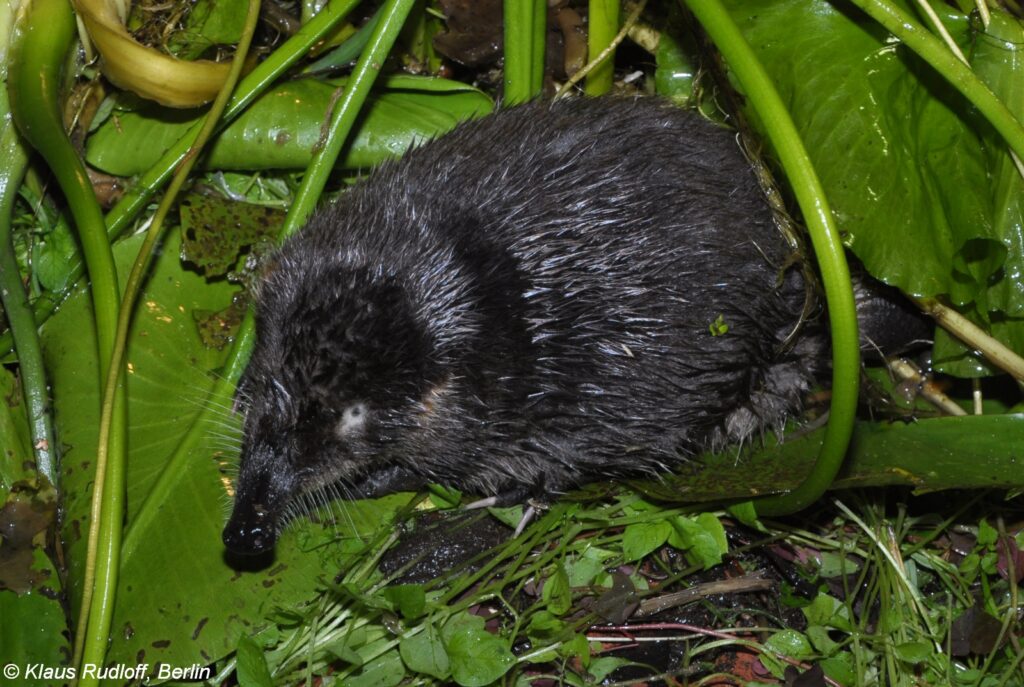
The Russian Desman is a critically endangered insectivore, related to moles but suited to aquatic life.
Population
In the 19th and early 20th century, they were hunted for their coats. Two estimates put this hunting rate at 5000 – 20,000 skins per year, and 50,000 – 100,000 per year. The hunting of the desman stopped in 1914, due to population depression and never returned.
Since then, the population has been catastrophically affected by changing land-use. Deforestation led to forest rivers becoming treeless and consequently dried up, marshes were drained and dry lands irrigated. Hydro-electric constructions in the 1930s and 1950s were thought to be caused the deaths of 600,000 – 800,000 individuals (Rutovskaya M.V., Onufrenya M.V., Onufrenya A.S. 2017).
In the 1970s, the population of Russian Desmans was estimated to be 70,000 individuals. The population dropped to 39,000 in 1985, and then to 27,000 in 2001. By 2017, research into burrow density and probable numbers per burrow put the population at 8000 – 10,000. If projections are correct, the population as of 2023 stands at 3,600.
Their low population isn’t helped by their strict habitat requirements. They live on the banks of oxbow lakes, where the water is 2m-6m deep and has rich vegetation. Reproduction and the abundance of the species depends on floods. If they are too high, the desman temporarily cannot reach its’ nest, whilst in winter, inhabited nests are flooded and the animal cannot reach the surface. Floods that are too low will also limit the reproduction of the desman (Rutovskaya M.V., Onufrenya M.V., Onufrenya A.S. 2017).
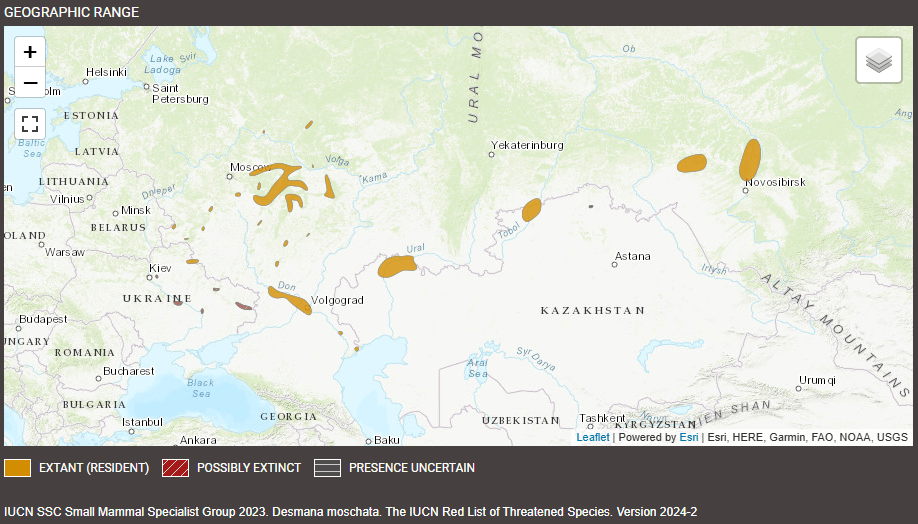
Threats
Fishing with stationary nets has developed into a serious threat for populations. These durable and cheap nets are often left in the water for days (potentially months) and are checked sporadically or abandoned entirely. Desmans will usually die within 5 – 10 minutes of being caught.
The environmental damage seen in the 20th century has reduced in the last decades. However, climate change could continue to impact the desman through modifying water flow regimes and water levels. Necessary spring floods are becoming more absent, whilst the winter floods mentioned earlier are getting worse (IUCN, 2023).
Conservation
There are protected buffer zones in Okskiy, Khopersky, Prisursky, and Ugra National Parks, which aim to maintain suitable habitats and mitigate threats. However, attempts to reintroduce the desman have largely been unsuccessful but small populations do exist. There have also been several attempts to breed the species in captivity but these have failed.
The Biodiversity Conservation Center has opened a desman nursery near Moscow with promising environmental and social perspectives. Counts are also conducted in the autumn by a group of student biologists and enthusiasts with the Desmana Club.

References:
rosalindk. (2023). Red List publication: Russian Desmans are now Critically Endangered – Small Mammals SG. Small-Mammals.org. https://small-mammals.org/2023/12/11/red-list-update/
Gazzard, A., Rutovskaya, M., & Turvey, S. (2023, March 29). IUCN Red List of Threatened Species: Desmana moschata. IUCN Red List of Threatened Species; Name. https://www.iucnredlist.org/fr/species/6506/231334630
Rutovskaya M.V., Onufrenya M.V., Onufrenya A.S. 2017. Russian desman (Desmana moschata: Talpidae) at the edge of disappearance. Nature Conservation Research 2(Suppl. 1): 100–112. https://dx.doi.org/10.24189/ncr.2017.020
 The Nature Folder